* All product/brand names, logos, and trademarks are property of their respective owners.
Ever tried turning your voice into text and ended up spending more time fixing mistakes than actually writing? You’re not alone. Most voice typing tools still struggle with accuracy, speed, or require a constant internet connection to work properly.
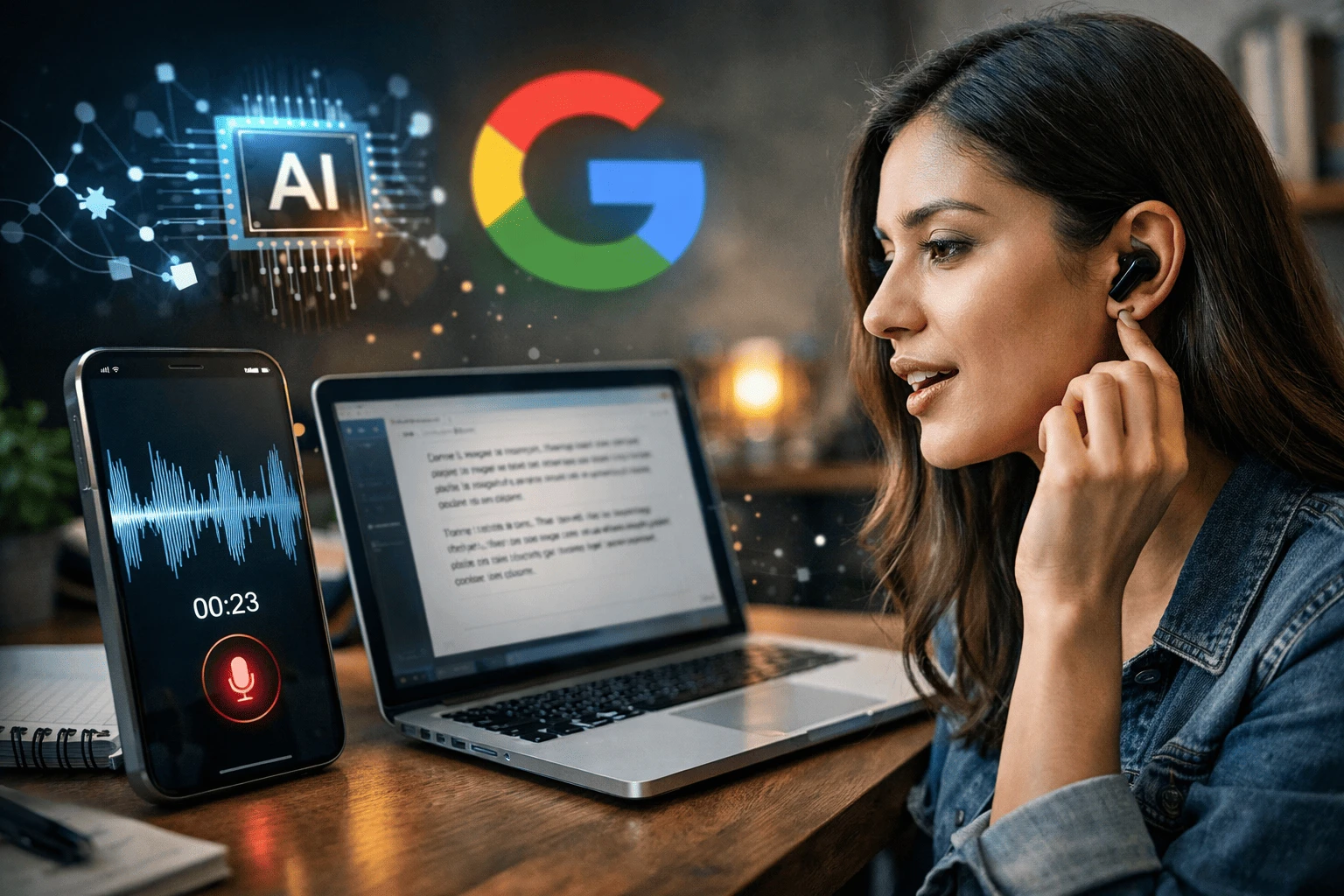
That’s where Google AI Edge Eloquent steps in — a new approach to speech-to-text that feels faster, smarter, and far more practical for everyday use. Instead of relying on cloud servers, it processes your voice directly on your device. That means quicker results, better privacy, and the ability to work even when you're offline.
What makes this especially interesting is how natural the experience feels. You speak, and the words appear almost instantly — clean, structured, and surprisingly accurate. Whether you're taking notes, writing content, or capturing ideas on the go, it removes a lot of the friction people usually face with voice typing.
In this guide, we’ll break down what Google AI Edge Eloquent actually is, how it works, and why it could change the way we interact with voice technology moving forward.
Google AI Edge Eloquent is Google’s new on-device speech-to-text experience built under its broader Google AI Edge platform. In simple terms, it is designed to listen to spoken language, turn it into written text, and do that work locally on the device instead of sending everything to the cloud. Google’s AI Edge platform highlights the same core benefits across its stack: lower latency, offline capability, and keeping data more local and private.
The “Edge” part is what makes this interesting. Edge AI means the intelligence runs closer to the user — on a phone, tablet, browser, or other device — rather than depending fully on a remote server. For speech tools, that can mean faster response times, less waiting, and a smoother experience when internet access is weak or unavailable. Google describes its AI Edge ecosystem as focused on bringing AI to mobile, web, and embedded apps with support for local processing and reduced latency.
Turning speech into clean, readable text might sound simple, but a lot is happening behind the scenes. Google AI Edge Eloquent improves this process by focusing on speed, accuracy, and local processing — all working together in real time.
As you speak, Eloquent converts your voice into text almost instantly. There’s no long delay or buffering. This makes it feel natural, like you're typing with your voice instead of waiting for results to catch up. For tasks like note-taking or capturing ideas quickly, this real-time response is a big advantage.
Unlike traditional tools that send your voice data to remote servers, Eloquent processes everything directly on your device. This means:
This is especially useful when traveling, working remotely, or dealing with unstable internet connections.
Eloquent uses advanced AI models trained to understand natural speech patterns. It doesn’t just transcribe word-for-word — it helps produce cleaner, more structured text. That means fewer errors, better punctuation, and less time spent editing afterward.
Instead of feeling like a raw transcription tool, it works more like a smart assistant that understands how people actually speak and turns that into usable text.
Google AI Edge Eloquent isn’t just another speech-to-text tool — its real strength comes from how it combines multiple advantages into one smooth experience. Here are the features that truly make it stand out.
One of the biggest highlights is its ability to function without an internet connection. Since everything runs on your device, you can dictate notes, messages, or ideas anytime, anywhere. This makes it especially useful during travel, in low-connectivity areas, or when you simply want a more reliable tool.
Because there’s no need to send data back and forth to the cloud, the response time is noticeably quicker. You speak, and the text appears almost instantly. This speed makes a big difference when you're trying to capture thoughts quickly or keep up with a fast conversation.
With growing concerns around data security, this feature stands out. Your voice data stays on your device instead of being uploaded to external servers. For professionals, journalists, or anyone dealing with sensitive information, this adds a strong layer of confidence.
Eloquent is designed to run efficiently on modern devices without draining resources. It doesn’t require heavy infrastructure or constant syncing, which means it can perform smoothly even on mobile devices.
The real value of Google AI Edge Eloquent becomes clear when you look at how it fits into everyday situations. It’s not just a tech upgrade — it’s a practical tool that can save time and effort across different types of work.
Students often struggle to keep up with fast-paced lectures. With Eloquent, they can simply record and speak key points while studying, and the tool converts everything into clean, readable notes. This makes revision easier and reduces the need to manually rewrite messy notes later.
For journalists, accuracy and speed are critical. Instead of manually transcribing interviews, Eloquent can handle the heavy lifting in real time. Since it works on-device, it’s also useful when covering stories in areas with limited connectivity.
Writers, YouTubers, and podcasters can use voice to quickly turn ideas into structured drafts. Speaking thoughts out loud is often faster than typing, and with cleaner transcription, there’s less editing required afterward.
In meetings, it’s easy to miss details while taking notes. Eloquent allows professionals to capture discussions as they happen, turning spoken conversations into organized text they can review later.
With so many speech-to-text tools available today, it’s natural to wonder how Google AI Edge Eloquent compares. While it’s still relatively new, it introduces a different approach that sets it apart from popular options.
| Tool | Deployment style | Strengths | Tradeoffs | Best fit |
|---|---|---|---|---|
| Google AI Edge Eloquent | On-device | Faster real-time transcription, lower setup complexity, smoother everyday user experience, better privacy, offline usability, faster response times | Still relatively new, may offer less advanced customization than some alternatives | Regular users, lightweight apps, privacy-focused and offline use cases |
| OpenAI Whisper | Mostly cloud-based or semi-local | High accuracy, strong flexibility, advanced customization | Often requires more technical configuration, less simple for everyday on-device use | Developers, advanced users, customized transcription workflows |
| Google Cloud Speech-to-Text | Cloud-based | Powerful speech-to-text capabilities | Requires stable internet, may have latency from network speed, data processed on remote servers | Cloud workflows, large-scale online transcription needs |
Key takeaway: Google AI Edge Eloquent is positioned less as a replacement for every speech-to-text tool and more as a practical on-device option focused on speed, privacy, and offline everyday use.
The shift toward on-device AI isn’t just a trend — it’s a clear direction where technology is heading. Tools like Google AI Edge Eloquent are part of a bigger movement to make AI faster, more private, and more accessible to everyone.
For years, most AI tools relied heavily on cloud servers to process data. While that worked, it also created delays and required constant internet access. On-device AI changes that by bringing processing directly to your device, reducing reliance on external systems.
Privacy has become a major concern worldwide. When your voice data stays on your device instead of being uploaded, the risk of data exposure drops significantly. This makes on-device AI especially valuable for professionals, businesses, and everyday users who care about data security.
Speed is one of the biggest advantages. Without needing to send data back and forth to servers, responses happen almost instantly. This creates a smoother, more natural interaction — especially for voice-based tools where timing matters.
Not everyone has access to fast or stable internet. On-device AI makes advanced tools usable in more places, from busy cities to remote areas. This opens the door for wider adoption and more inclusive technology.
Google AI Edge Eloquent shows how far speech-to-text technology has come — and where it’s going next. Moving processing directly onto your device, it solves some of the biggest frustrations people have faced with traditional voice typing tools, like lag, privacy concerns, and constant internet dependency.
What makes it stand out isn’t just the technology itself, but how practical it feels in real use. Whether you're a student capturing notes, a professional managing meetings, or a creator turning ideas into content, the ability to speak and instantly get clean, usable text can save both time and effort.
While it’s still early and not fully available to everyone yet, the direction is clear. Tools like this are setting the stage for a future where interacting with devices feels more natural — less typing, more speaking.
If you’ve been waiting for voice-to-text tools to truly feel reliable and efficient, this might be the shift that finally delivers.
If you want a deeper breakdown, check out Edge Analytics vs Cloud Analytics: Which One Wins

I am Zeenat, an SEO Specialist and Content Writer specializing in on-page and off-page SEO to improve website visibility, user experience, and performance.
I optimize website content, meta elements, and site structure, and implement effective off-page SEO strategies, including link building and authority development. Through keyword research and performance analysis, I drive targeted organic traffic and improve search rankings.
I create high-quality, search-optimized content using data-driven, white-hat SEO practices, focused on delivering sustainable, long-term growth and improved online visibility.
For more than two decades, Google’s search box has been one of the simplest and most recogniza
22 May 2026
Google has entered one of those phases where it feels like every week brings another shift. One day
22 April 2026
When you open Google, that simple logo sometimes turns into something unexpected — colorful, a
14 April 2026
Be the first to share your thoughts
No comments yet. Be the first to comment!
Share your thoughts and join the discussion below.