* All product/brand names, logos, and trademarks are property of their respective owners.
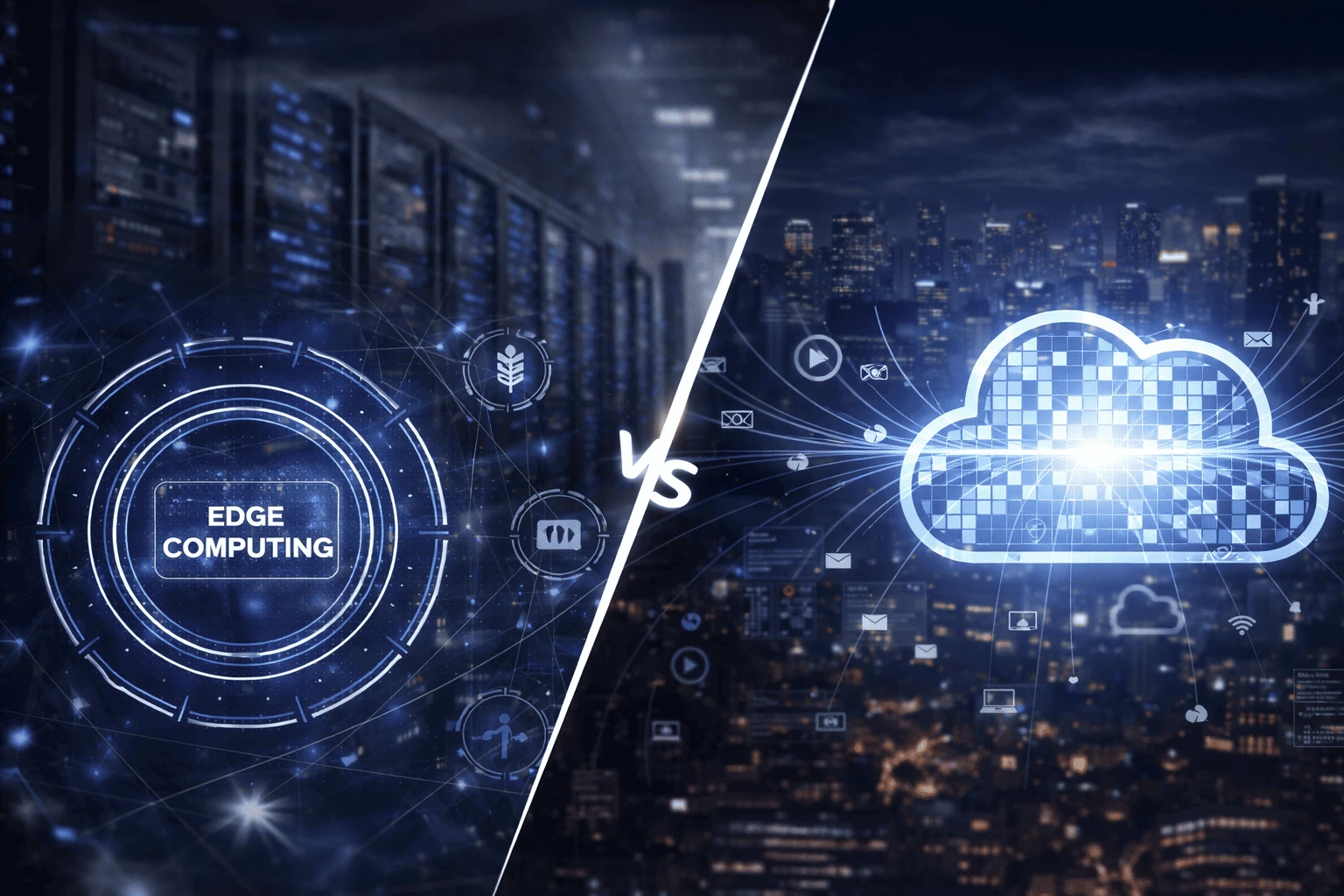
On one side, you have edge analytics, designed for speed and immediate decision-making. It processes data right where it’s created — on devices, sensors, or local gateways. On the other side, you have cloud analytics, built for scale and deep strategic insight. It centralizes data in powerful data centers to run advanced models and long-term analysis. So which one wins? The honest answer depends on your business goals. If you need real-time reactions, Edge may be your champion. If you need large-scale intelligence and forecasting, the cloud might take the lead. Let’s break it down clearly and practically.
The way businesses handle data has changed dramatically. Today, machines, apps, vehicles, and sensors generate data every second. The real challenge is no longer just collecting data — it’s deciding where and how to analyze it. That’s where the debate around edge analytics vs cloud analytics becomes important.
Edge analytics focuses on processing data locally, near the source. Instead of sending every piece of information to the cloud, the system analyzes it on-site and makes decisions instantly. This approach is especially useful in environments where speed, reliability, and reduced bandwidth matter most.
At its core, edge analytics is decentralized data processing. Imagine a smart factory with sensors tracking temperature, vibration, and machine performance. If every data point were sent to the cloud, delays could occur. With edge analytics, data is processed on a local device or gateway. Only important insights are forwarded to the cloud.
This means:
Immediate local decisions
Reduced data transfer
Lower bandwidth costs
Faster operational response
Edge devices can even run lightweight AI models directly. For example:
A security camera identifies unusual movement instantly.
A machine detects early signs of failure.
A payment system flags suspicious activity in real time.
The intelligence happens at the source — not miles away in a data center.
Latency refers to the time it takes for data to travel and be processed. In some industries, even a small delay is unacceptable.
Consider:
Autonomous vehicles reacting to road conditions
Industrial robots stopping to prevent accidents
Healthcare devices detecting irregular heartbeats
Fraud detection systems blocking suspicious transactions
In these cases, waiting for cloud processing can be too slow. Edge analytics works in milliseconds. That speed improves safety, reduces downtime, and enhances customer experience. When real-time action matters, edge analytics clearly shines.
Speed is important, but edge analytics offers more than just fast responses.
Bandwidth and Cost Savings:
Sending massive amounts of raw IoT data to the cloud is expensive. Edge systems filter out unnecessary data and send only relevant insights. This reduces cloud storage and transfer costs.
Reliability in Remote Areas:
Not every environment has stable internet. Oil rigs, ships, mining sites, and rural healthcare centers cannot depend entirely on cloud connectivity. Edge systems continue operating even if the internet goes down.
Improved Security and Data Control:
By keeping sensitive data local, organizations reduce exposure during transmission. This helps with compliance and data sovereignty regulations. In short, edge analytics excels in environments where speed, reliability, and localized control are critical.
While edge analytics focuses on immediate action, cloud analytics focuses on the bigger picture. Cloud analytics centralizes data from multiple sources into large data centers. There, advanced tools process, store, and analyze information at scale. It’s less about milliseconds and more about long-term intelligence.
In a cloud analytics setup:
Data from devices, applications, and systems is sent to the cloud.
It is stored in data lakes or warehouses.
Advanced analytics tools process it.
Dashboards and insights are delivered to decision-makers.
This centralized model allows organizations to combine data from different locations and departments.
For example:
A global retailer can compare sales across countries.
A bank can analyze years of transaction data.
A manufacturer can track performance across multiple factories.
Cloud analytics thrives on aggregation and scale.
One major advantage of cloud analytics is computational power. Cloud platforms offer virtually unlimited resources. Businesses can:
Train complex AI models
Run simulations
Process large historical datasets
Scale up during peak demand
There’s no need to buy physical hardware. Companies simply scale resources as needed, often through subscription-based pricing. This flexibility makes cloud analytics ideal for growing enterprises and global organizations.
Cloud analytics shines when it comes to holistic insight. Edge systems might detect a machine problem instantly. But cloud analytics can analyze months or years of data to predict future failures.
Similarly:
Edge fraud detection blocks suspicious transactions in real time.
Cloud analytics studies long-term fraud patterns to improve risk models.
Cloud platforms help leaders answer strategic questions like:
What trends are shaping our industry?
Where should we invest next year?
How can we optimize operations globally?
For long-term planning and enterprise-wide visibility, cloud analytics takes the lead.
Both technologies are powerful, but neither is perfect.
Edge analytics delivers speed but may lack the depth of large-scale historical analysis. Cloud analytics provides deep insights but introduces latency. If your priority is instant response, edge wins. If your priority is complex modeling and forecasting, cloud wins.
Edge systems can operate offline. Cloud systems require reliable internet connectivity. In remote or unstable environments, edge analytics is more dependable. In well-connected urban settings, cloud systems operate smoothly. Infrastructure maturity often influences the decision.
Edge analytics may require upfront investment in hardware. However, it reduces ongoing data transfer costs. Cloud analytics reduces hardware investment but introduces subscription fees and potential data transfer expenses. Organizations must evaluate total cost of ownership rather than just initial pricing.
Edge analytics keeps sensitive data local, supporting compliance requirements. Cloud providers invest heavily in security, but centralizing data can create concentration risk. The right choice depends on regulatory obligations and risk tolerance.
In reality, most modern enterprises do not choose one over the other. They adopt a hybrid approach.
In a hybrid architecture:
Edge handles immediate data filtering and real-time decisions.
The cloud aggregates data for long-term analysis.
AI models are trained in the cloud and deployed back to edge devices.
This creates a continuous improvement loop.
For example, in manufacturing:
Edge systems detect equipment issues instantly.
Cloud analytics studies historical patterns to improve predictive models.
The result is both speed and intelligence.
Different industries benefit from hybrid models:
Healthcare: Real-time monitoring at the edge, research insights in the cloud.
Fintech: Instant fraud detection at the edge, risk modeling in the cloud.
Retail: Local inventory tracking at the edge, demand forecasting in the cloud.
Smart Cities: Real-time traffic control at the edge, urban planning analytics in the cloud.
Hybrid strategies reduce blind spots and maximize performance.
With the rise of AI and 5G, hybrid analytics is becoming even more powerful. 5G enables faster communication between edge and cloud systems. Meanwhile, lightweight AI models allow intelligent processing directly on devices. The future of analytics is not centralized or decentralized — it is coordinated.
So, Edge Analytics vs Cloud Analytics: Which One Wins? If your priority is real-time decision-making, low latency, and local control, edge analytics is the champion. If your goal is deep insight, large-scale modeling, and strategic forecasting, cloud analytics leads the way. But for most modern enterprises, the real winner is a hybrid architecture that combines both.
The smartest organizations design their analytics strategy around their specific operational needs, regulatory requirements, and long-term goals.
Instead of asking which technology wins, the better question is: What problem are you trying to solve?
Related Article
The Power of Real-Time Data: Why Instant Insights Win

Waqar Azeem is a digital marketing and web development specialist who bridges the gap between marketing and engineering. On the marketing side, he works extensively with Google Ads, Google Merchant Center, and Google Analytics — managing campaigns, product feeds, and conversion tracking to help businesses grow their online visibility and sales. On the development side, he builds and maintains web applications using Yii2 and Next.js, giving him a rare ability to handle both the technical infrastructure and the marketing performance of a website. This combined skill set lets him approach projects holistically, ensuring that what gets built is also built to perform.
Something big has changed in the way we use data—and most people haven’t fully caught up
20 April 2026
Imagine knowing what your customers want before they even ask. Picture preparing for market shifts,
20 January 2026
In today’s fast-paced world, speed isn’t just a competitive advantage — it’s
12 January 2026
Be the first to share your thoughts
No comments yet. Be the first to comment!
Share your thoughts and join the discussion below.

.webp&w=3840&q=75)
.webp&w=3840&q=75)