* All product/brand names, logos, and trademarks are property of their respective owners.
Moving from manual work to AI-powered systems sounds exciting, but it can also feel risky without a clear plan. Many businesses rush into automation because they want faster results, lower costs, and fewer delays. The problem is that AI does not fix a messy process by itself.
That is why a strong AI conversion strategy matters. It gives businesses a practical path for turning repetitive manual tasks into smarter, faster, and more reliable workflows. The goal is not to replace people everywhere. The goal is to use AI where it adds real value while keeping human judgment where it is still needed.
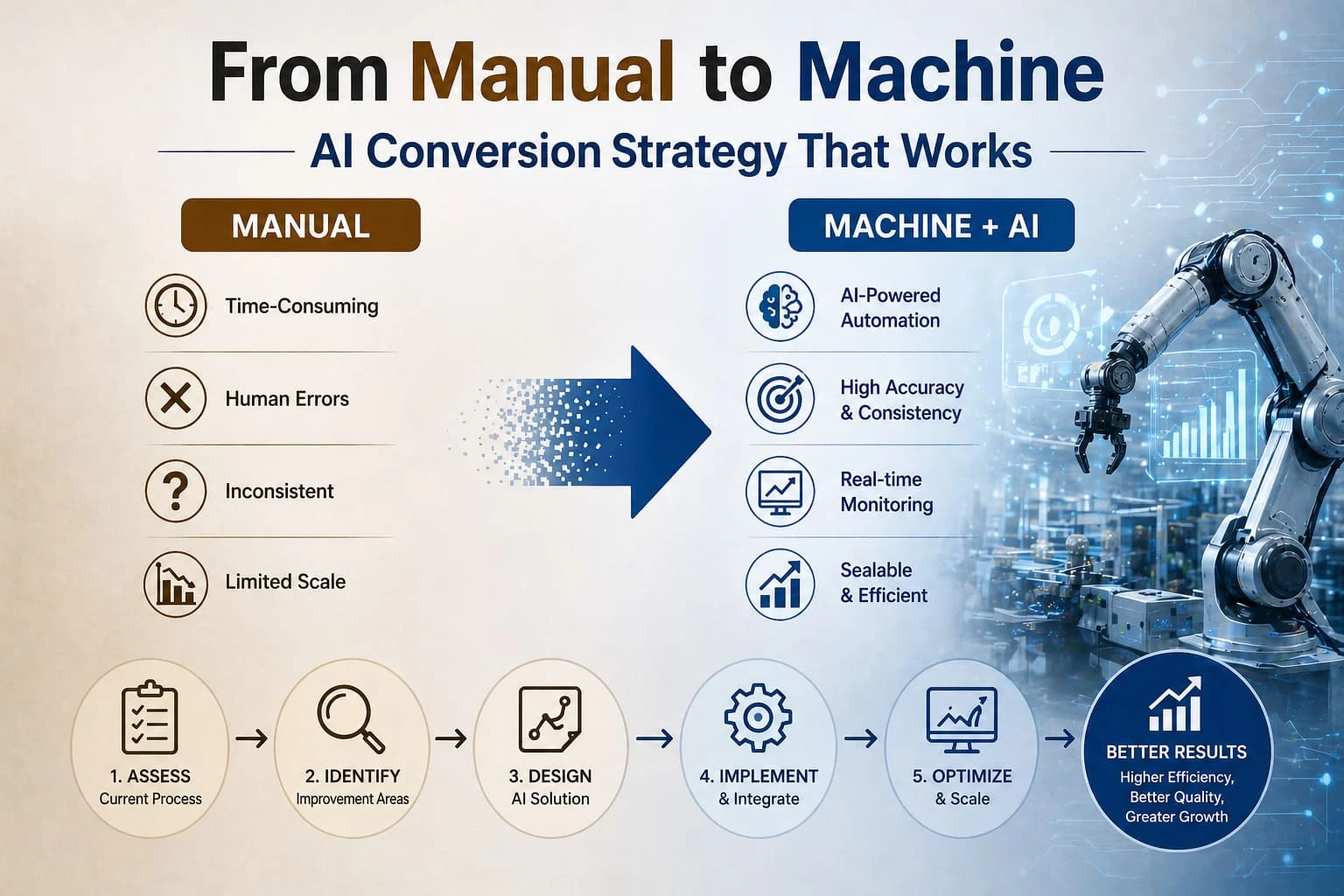
The shift from manual work to AI systems is not only about using new technology. It changes how work moves through a business.
In a manual setup, people collect data, check information, send updates, write reports, approve requests, and repeat the same steps daily. This may work when the workload is small, but it becomes harder as the business grows.
AI-powered systems change that pattern. AI can sort information, detect patterns, prepare drafts, flag errors, and speed up routine decisions. Employees move from doing repetitive work to managing, reviewing, improving, and making better decisions.
| Area | Manual Process | AI-Powered Process |
|---|---|---|
| Speed | Depends on staff availability | Runs faster and more consistently |
| Accuracy | More exposed to repeated errors | More reliable with clean data |
| Scale | Requires more people as volume grows | Handles higher volume with less strain |
| Cost | Labor-heavy over time | Higher setup cost, lower repeat cost |
| Human Role | Performs most tasks directly | Reviews, approves, and improves outputs |
This comparison shows the real value of AI. It does not simply do the same work faster. It changes the structure of the workflow. People no longer need to spend hours copying data, sorting requests, or preparing the same reports again and again.
Many businesses adopt AI because it sounds like the next logical step. But without a clear direction, most efforts stall or fail to deliver real value. A structured AI conversion strategy connects automation directly to business outcomes.
A well-planned AI conversion strategy ensures automation is applied where it creates real impact, not just where it looks impressive.
A successful transition from manual work to AI does not happen all at once. It follows a structured path.
Start by breaking down the current process in detail.
This step matters because automating a broken process only makes the problems faster.
Not every task should be automated immediately. Focus on areas where AI can deliver quick and clear value.
Good starting points include:
Avoid starting with tasks that require deep judgment, creativity, or sensitive decision-making.
AI systems depend on data. If the data is incomplete, outdated, or inconsistent, the results will not be reliable.
Review:
Clean and organized data is one of the strongest foundations for successful automation.
Start with one workflow or department instead of transforming everything at once.
A pilot should include:
This allows the business to test assumptions, find gaps, and improve the system before scaling.
AI works best when it supports people, not when it replaces oversight completely.
Use AI for:
Keep humans responsible for:
This balance builds trust and reduces risk.
Once the system is running, track performance closely.
Useful metrics include:
Use these insights to refine workflows, adjust rules, and improve accuracy over time.
Only expand after the pilot delivers consistent results. Scaling too early is one of the easiest ways to create confusion.
Strong scaling includes:
A structured AI conversion strategy turns automation into a controlled process instead of a risky experiment.
Some manual tasks are ideal for early AI adoption because they follow patterns and repeat often.
Strong candidates include:
Starting with these tasks helps businesses see measurable improvements without disrupting critical decision-making processes.
AI can handle many structured tasks, but some areas should stay human-led during the early stages.
These include:
Keeping these tasks human-led does not mean avoiding AI. AI can still assist by preparing drafts, summarizing information, or highlighting risks while people stay in control.
Many AI projects fail because teams rush or skip important steps.
Common mistakes include:
Avoiding these mistakes can save time, money, and frustration. A careful, step-by-step approach leads to stronger outcomes.
A strong AI conversion strategy depends on tracking the right results from the start.
Key metrics include:
These numbers show whether AI is actually improving the business or simply adding another tool to the workflow.
A successful AI conversion strategy is not about rushing into automation or chasing the latest tool. It is about building a clear path from manual work to smarter systems that improve how the business operates.
The most effective approach is simple: map the workflow, select the right tasks, start with a focused pilot, measure results, improve the process, and scale only after success is proven.
Businesses that follow this path reduce risk, avoid common mistakes, and create systems that deliver long-term value. Start with one manual workflow, break it down, and identify where AI can make the biggest difference. That first step can set the direction for a stronger, smarter way of working.

No bio available yet.
Let’s be blunt: generic marketing is dead. In an ultra-competitive digital ecosystem wher
22 January 2026
Are your marketing efforts actually driving results — or are you just guessing? In today&rsquo
14 January 2026
Every eCommerce business has felt the sting of it — a shopper adds items to their cart, heads
8 December 2025
Be the first to share your thoughts
No comments yet. Be the first to comment!
Share your thoughts and join the discussion below.
.webp&w=3840&q=75)
.webp&w=3840&q=75)
.webp&w=3840&q=75)